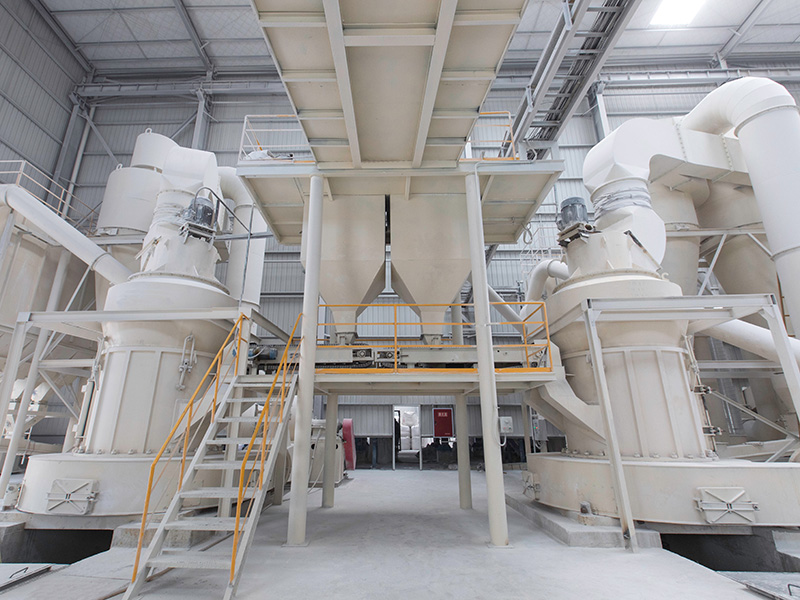

In the industrial powder grinding industry, the Raymond mill is a classic and time-tested equipment. It is widely used in the processing of non-metallic ores such as calcium carbonate, talc powder, gypsum, bentonite and kaolin, covering most powder production lines.
However, many practitioners who have operated Raymond mills for years never fully understand its core grinding logic or its unique advantages over other grinding equipment. This article avoids obscure professional parameters, uses plain and straightforward language to comprehensively explain the working principle and performance advantages of Raymond mills, and objectively illustrates their limitations and operational notes to help you fully master this equipment.
Core Working Principle: Three Steps to Understand How Stones Turn Into Powder
The core operating logic of a Raymond mill can be summarized as mechanical crushing + air classification. The two systems work collaboratively: one crushes raw materials, and the other screens qualified powder. The whole process adopts automatic closed-loop operation with a simple and efficient workflow. The complete grinding process is divided into three steps:
Step 1: Feeding and Material Positioning
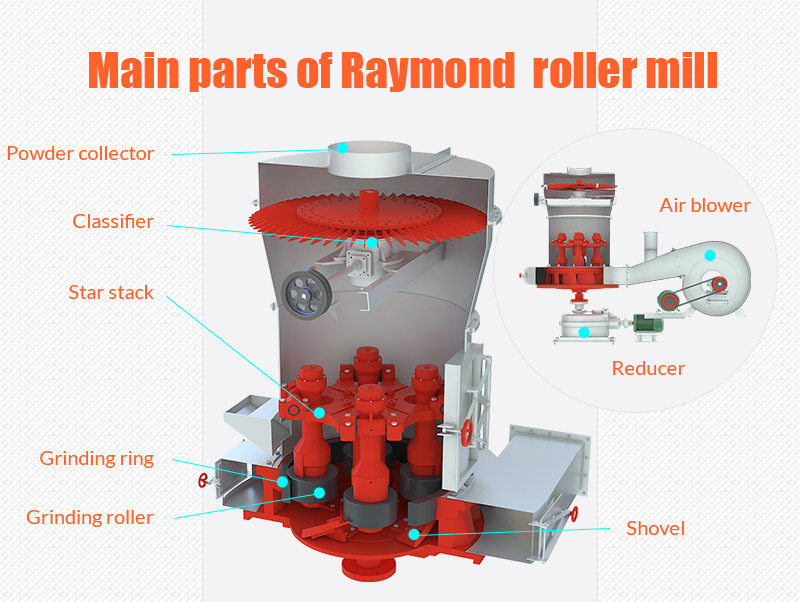
Block ore raw materials fall naturally from the feed hopper into the main grinding chamber. The core grinding components — grinding rollers — operate in a compound motion instead of fixed rotation. They revolve around the main spindle while rotating independently, maintaining a continuous working state to accurately receive falling materials and prepare for subsequent rolling and grinding.
Step 2: Centrifugal Rolling and Reciprocal Crushing
During operation, the high-speed revolution of grinding rollers generates strong centrifugal force, pressing the rollers tightly against the outer grinding ring to form a high-pressure grinding working surface. Meanwhile, the built-in scraper blades keep rotating, scooping up accumulated materials at the bottom and delivering them precisely to the gaps between grinding rollers and the grinding ring.
With continuous rolling and extrusion of the rollers, bulk materials are crushed instantly and gradually ground into fine powder particles. This rolling process is circulated repeatedly to ensure materials are fully polished in the grinding zone, completing the primary crushing operation.
Step 3: Air Classification and Closed-Loop Grinding
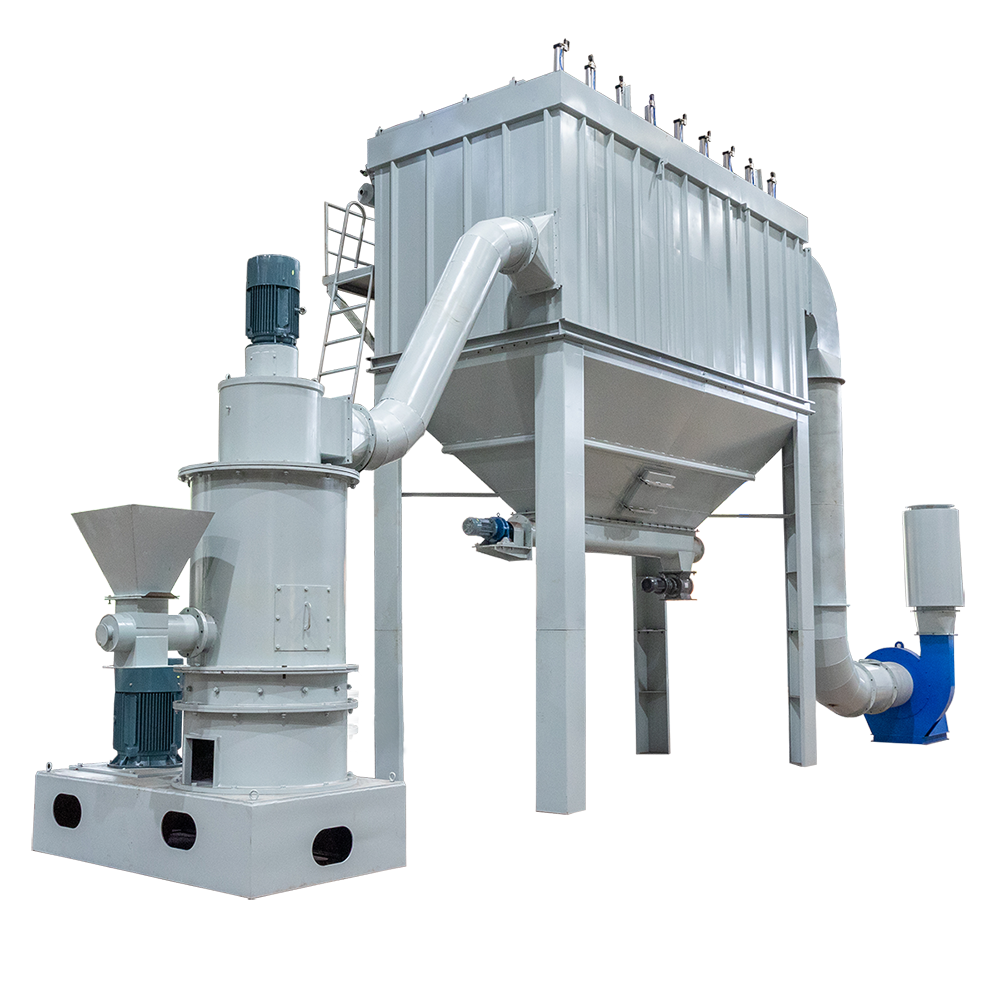
The initially ground powder particles are blown upward by the negative pressure airflow generated by the bottom fan and delivered to the top classifier for particle size screening.
The classifier accurately separates powder according to fineness standards:
1. Coarse powder: Particles failing to meet the fineness standard are intercepted and fall back to the grinding zone automatically for re-grinding until they reach the qualified size;
2. Qualified fine powder: Eligible powder moves with the airflow into the cyclone collector. After gas-solid separation, finished powder is stably discharged from the powder outlet.
The entire equipment adopts a negative pressure circulating air duct design, which prevents powder overflow fundamentally, controls dust pollution and meets industrial environmental protection production standards.
Principle Summary: The Raymond mill realizes continuous and automatic processing from bulk ore to finished powder through the core combination of mechanical rolling crushing and air powder classification, featuring clear division of labor and closed-loop operation.
Core Performance Advantages: Why It Remains Popular in the Industry
The long-term mainstream position of Raymond mills in the small and medium-sized powder processing market is no accident. Its core advantages perfectly fit the production needs of small and medium-sized processing plants with high practicality:
1. Stable Structure, Durable and Low Failure Rate
The equipment adopts a closed gearbox and pulley transmission structure, ensuring stable transmission and good sealing performance. It effectively avoids dust blockage and greatly reduces failure risks. In addition, core load-bearing components such as the main spindle and spider frame are optimized and upgraded. The whole machine runs with low vibration and high stability, free from jitter and abnormal noise caused by long-term operation. It requires less daily maintenance and delivers reliable long-term operation.
2. Wide Adjustable Fineness, Multi-purpose and Cost-effective
Powder processing requires different fineness for different products. The Raymond mill features strong adaptability. Without replacing equipment or modifying core structures, users can adjust the discharge fineness flexibly by changing the rotating speed of the top classifier. It stably supports powder production ranging from 80 mesh to 325 mesh, meeting multiple production scenarios of coarse and medium-fine powder. One machine replaces multiple special grinding devices, greatly reducing equipment procurement costs.
3. Built-in Safety Protection, Lower Production Risks
To solve the safety risks of processing flammable and explosive materials in powder grinding, Raymond mills are equipped with explosion-proof structures on the upper body. This design effectively reduces the risk of machine explosion during grinding, safeguards the safe operation of production lines, and balances production efficiency and safety performance.
Objective Evaluation: Limitations and Common Problems of Raymond Mills
No industrial equipment is perfect. Raymond mills have certain application limitations. Most common production problems are not caused by inherent equipment defects, but by improper model selection, material mismatch and inadequate maintenance:
1. Unqualified Output: Materials with excessive hardness or high humidity are prone to adhesion and difficult to grind, directly leading to a significant drop in equipment output;
2. Fast Wear of Wearing Parts: Grinding rollers and grinding rings are core vulnerable parts. Low-quality accessories wear rapidly under long-term high-pressure rolling and need replacement within several months, increasing operation and maintenance costs;
3. Reduced Output at High Fineness: When producing powder close to the high standard of 325 mesh, the classification difficulty increases significantly, resulting in reduced screening efficiency and lower overall output.
Summary
The Raymond mill has become an evergreen equipment in the industrial powder grinding industry thanks to its mature principle and market-adaptive performance.
In terms of working principle, the combined mode of rolling crushing and air classification features simple workflow, high efficiency and environmentally friendly closed-loop operation;
In terms of performance, it boasts stable structure, adjustable fineness, reliable safety, strong adaptability to most non-metallic ore grinding scenarios and outstanding cost performance.
Mastering the working logic and pain points of Raymond mills helps optimize equipment selection and daily operation and maintenance, solving various practical production problems effectively.
Welcome industry practitioners to communicate and discuss! Have you encountered problems such as insufficient output, rapid wear of grinding rollers or inaccurate fineness adjustment when using Raymond mills? Share your solutions in the comment section.